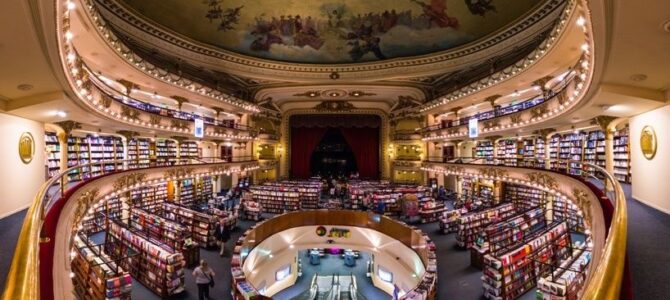
The Capital of the Printed Word in the Digital Age
Buenos Aires has earned an unusual distinction in the global retail landscape: it is widely described as having the highest concentration of bookstores per capita in the world. The comparison is especially striking because the city outpaces better-known cultural capitals such as London and Madrid. Research reported by The Guardian identified at least 734 bookstores serving approximately 2.8 million residents, a density that turns book retail from a niche activity into a visible feature of everyday urban life.
This resilience matters because bookstores have faced the same pressures that weakened physical retail elsewhere. E-commerce platforms can carry enormous inventories, compare prices instantly, and use aggressive discounts to draw customers away from local shops. Yet Buenos Aires bookshops continue to anchor neighborhood commerce, attract evening foot traffic, and serve as meeting points for readers, students, writers, and cultural organizations. Their survival is not simply a consequence of nostalgia or a particularly loyal customer base. It reflects a commercial environment in which public policy and urban form reduce some of the disadvantages faced by independent retailers.
Buenos Aires therefore offers a practical masterclass for urban planners, retail strategists, and policymakers. Three forces work together: statutory protection for book prices, a dense and walkable cultural corridor, and a substantial pool of intellectual capital that creates demand for specialist knowledge and backlist titles. Each factor is useful on its own, but their combined effect is more important. Regulation protects the margin, urban design brings people past the storefront, and literary culture gives consumers a reason to enter.
Regulatory Armor and the Economics of Fixed Book Price Policy
Argentina”s Law 25.542 establishes a uniform public sale price for books. In practical terms, publishers, importers, or their representatives set the final consumer price for the titles they release or bring into the country, creating a common reference price across retail channels. The full statutory framework, including provisions concerning discounts, exemptions, enforcement, and related institutions, is available in the RESUMEN – Ley 25542 – LIBROS published by Argentina”s national government.
The commercial significance is straightforward. In an open discount market, a large platform can sell a popular title below cost, or at a minimal margin, to acquire customers and weaken smaller competitors. An independent bookstore usually cannot match that strategy because it has less purchasing power, fewer revenue streams, and higher relative staffing costs. Uniform pricing removes much of the incentive for this form of loss-leading competition. A customer may still choose a shop for its location, service, curation, or atmosphere, but the independent retailer is not automatically defeated at the point of price.
The policy also has consequences beyond individual store survival. The Argentine publishing sector includes large commercial houses, specialist publishers, independent presses, and regional distributors. If discounting consistently rewarded only the highest-volume titles, publishers would have stronger incentives to concentrate on predictable bestsellers. The Cámara Argentina del Libro argues that price competition can narrow bibliodiversity, while a uniform-price framework helps sustain a wider editorial offering. It also points to paper as a major production cost, meaning that heavy discounting does not necessarily create a sustainable path toward lower prices. Instead, it can compress retailer margins, encourage higher list prices, and make smaller bookstores more vulnerable.
| Operational metric | Open-market discounting | Regulated uniform-price market |
|---|---|---|
| Price competition | Large platforms can discount aggressively | Retailers compete less through price |
| Independent-store margin | Highly exposed to purchasing-power differences | More stable across retail channels |
| Editorial diversity | Commercial winners may dominate shelf space | Specialist and lower-volume titles have better protection |
| Customer decision factors | Price and convenience tend to dominate | Service, curation, location, and experience matter more |
| Market structure | Scale advantages favor major platforms | Smaller retailers retain a more viable competitive position |
Fixed pricing is not a universal solution to retail disruption. Bookstores still face rent increases, inflation, logistics constraints, changing reading habits, and competition from digital formats. However, it addresses a specific structural problem: the ability of a dominant seller to use its scale to make price the only meaningful competitive variable. For policymakers, that distinction is important. Effective regulation does not preserve every existing business automatically, but it can prevent a market from being organized entirely around the financial power of its largest participant.
The Architecture of Avenida Corrientes and Walkable Commerce
Avenida Corrientes demonstrates how urban design can convert cultural activity into repeat retail traffic. The avenue runs from Puerto Madero to Chacarita, crossing neighborhoods associated with tango, theater, cafés, and literary life. Its most concentrated bookstore environment is the central stretch between Esmeralda and Callao, where bookshops operate alongside theaters, pizzerias, bars, and other evening destinations. The city”s cultural tourism guide describes this corridor as a place where visitors can attend a performance, eat pizza with fainá, and continue browsing for books after nightfall through Las librerías de Calle Corrientes.

The pedestrianization of part of the corridor strengthens that relationship between culture and commerce. Since April 2019, the section between Callao and Libertad has been pedestrian-only after 7 p.m. This does not turn the entire avenue into a car-free district, but it creates a meaningful evening environment in one of the city”s most culturally active areas. Reduced vehicle dominance improves the conditions for strolling, window-shopping, informal encounters, and flexible movement between venues. For bookstores, those behaviors are commercially valuable because browsing is often unplanned and requires time.
The corridor works as an ecosystem rather than a collection of isolated shops. Theatergoers generate evening demand, pizzerias extend the duration of visits, and bookstores provide an activity that can begin before or continue after a performance. Late opening hours are particularly important because they align retail operations with the actual rhythm of local cultural consumption. A bookstore that closes when the theater district becomes busiest misses the most relevant customer window.
- Density: multiple bookstores and cultural venues make the area worth visiting as a destination.
- Temporal alignment: late opening hours connect retail operations to theater, dining, and nightlife.
- Walkability: pedestrian space encourages slow movement and spontaneous entry into shops.
- Complementarity: theaters, cafés, pizzerias, bars, and bookstores reinforce one another rather than competing for identical demand.
- Programmed activity: events such as the Night of the Bookstores add talks, presentations, roundtables, promotions, and reasons to return.
For urban planners, the lesson is not to copy Avenida Corrientes superficially. A pedestrian zone without cultural anchors may produce little retail value, while a bookstore district without safe and convenient evening access may remain underused. The stronger model combines destination uses, extended operating hours, public programming, and a street environment that supports walking. The result is a high-density cultural corridor in which the act of buying a book becomes part of a broader night out.
Intellectual Capital as an Economic Buffer
Buenos Aires has an unusually deep literary and intellectual ecosystem. Its publishing history was strengthened by mass European immigration in the late nineteenth and early twentieth centuries, when multilingual communities helped create a flourishing environment for journalism, publishing, and the arts. The city also has a longstanding reputation for psychoanalysis, literary debate, academic discussion, and café-based intellectual life. These traditions create demand that is more complex than a search for the latest mass-market bestseller.
That complexity supports physical curation. A knowledgeable bookseller can connect a reader interested in psychoanalysis with an older translation, a specialist monograph, a local independent press, or a related literary work that an algorithm may not prioritize. This matters particularly in categories where context and trust influence the purchase decision. Secondhand books, rare editions, academic material, specialist manuals, and children”s literature all benefit from informed selection. The bookstore becomes a filter, adviser, and cultural institution, not merely a warehouse with a checkout counter.
The scale of local production reinforces this effect. The research reported by The Guardian noted that published titles rose from 16,092 in 2004 to 28,010 during the following decade, while 123 million books were printed in 2014. Those figures indicate a market capable of generating substantial variety, but variety only becomes commercially useful when readers can discover it. Independent booksellers perform that discovery function through displays, recommendations, events, and neighborhood knowledge.
Print also retains a practical and emotional role in Argentine consumer habits. Digital screens are effective for speed, storage, and search, but physical books support annotation, collecting, gifting, and visible participation in a cultural community. In Buenos Aires, the book remains both a product and a social signal. That makes the physical shop relevant even when the same title can technically be purchased elsewhere.
Translating Argentine Retail Resilience to Global High Streets
Buenos Aires cannot be reproduced by importing one regulation or redesigning one street. Its bookstore economy depends on history, market scale, consumer behavior, and cultural infrastructure that developed over decades. Nevertheless, its operating logic can be translated into practical measures for other cities and independent businesses.
- Protect fair competition rather than preserving inefficient habits. Policymakers should examine whether dominant platforms can use below-cost discounting, exclusive arrangements, or data advantages to eliminate smaller competitors. Uniform pricing may be appropriate for culturally important goods such as books, but the broader principle is market neutrality: businesses should compete on service and value, not merely on who can absorb the largest short-term loss.
- Design retail corridors around dwell time. Successful high streets need reasons for people to stay. Bookstores benefit when they are close to theaters, cafés, restaurants, libraries, galleries, and public events. Planners should evaluate the full customer journey, including evening safety, pedestrian comfort, public seating, lighting, and connections between venues.
- Invest in curation as a service. Independent retailers should not try to win an inventory contest against global platforms. Their advantage lies in selection, expertise, local relevance, and human guidance. Specialist sections, staff recommendations, reading groups, author presentations, used-book exchanges, and partnerships with schools or universities can turn limited floor space into a high-value experience.
- Measure cultural retail as infrastructure. Bookstores generate benefits that are not captured by a single transaction. They support literacy, neighborhood identity, independent publishing, tourism, and social connection. Municipal strategies should therefore assess bookstore districts through foot traffic, event participation, vacancy reduction, and cultural access, alongside conventional sales indicators.
The strongest lesson is that physical retail needs an operating environment, not simply encouragement. Rent relief may help temporarily, but long-term resilience requires a combination of predictable regulation, accessible streets, complementary destinations, and a customer proposition that digital platforms cannot easily replicate. Independent owners should map the surrounding ecosystem before selecting a location or business model. A shop near cultural activity, public transport, educational institutions, or established evening commerce has a better chance of converting casual movement into regular visits.
Businesses should also distinguish between inventory volume and inventory intelligence. A small store can compete when its selection is legible and purposeful. Clear specialization, strong staff knowledge, flexible ordering, and active community programming can produce higher customer value than a larger but undifferentiated stockroom. The Buenos Aires model rewards businesses that make discovery easier and more memorable.
Rethinking the Future of Brick-and-Mortar Commerce
Buenos Aires shows that the survival of physical retail is not an accidental victory over technology. It can be the deliberate outcome of policy and urban design. Law 25.542 limits the destructive effect of extreme price competition, while the cultural architecture of Avenida Corrientes concentrates people, activities, and reasons to browse. Intellectual capital then supplies the demand for specialist knowledge, diverse publishing, and trusted human recommendations.
The wider implication reaches beyond bookstores. Independent businesses thrive when cities treat them as elements of public infrastructure rather than as isolated transaction points. A bookstore can support literacy and cultural participation; a theater can sustain restaurants and evening foot traffic; a walkable street can make all of those uses more productive. Protecting this network requires ongoing attention to competition rules, pedestrian design, cultural programming, and the costs that determine whether small operators can remain in place.
Digital centralization will continue to challenge local commerce, especially as platforms expand their logistics, recommendation systems, and payment ecosystems. The answer is not to reject digital tools, but to ensure that digital scale does not erase every alternative. Buenos Aires offers a forward-looking principle: when regulation creates fairer conditions, urban design encourages human movement, and businesses deliver genuine cultural expertise, physical retail can remain economically relevant and socially indispensable.