Patagonia Wind Paradox and the Clean Power Frontier
Patagonia offers one of the world”s most compelling wind investment propositions. In parts of southern Argentina and Chile, exceptionally strong and consistent winds can produce capacity factors routinely above 50 percent, while the Haru Oni project in Chile”s Magallanes province has described the local resource as capable of delivering up to 6,000 full-load hours for renewable generation. That quality changes the economics of wind development: a turbine in Patagonia can produce substantially more electricity from the same installed megawatt than a comparable machine in a weaker resource area.
The commercial paradox is that the best generation resource is far from the largest electricity demand. Industrial consumption is concentrated around Greater Buenos Aires, the central provinces, mining districts, and other northern or interior load centers. Between those locations and the strongest southern wind sites lie transmission constraints, long distances, difficult terrain, limited logistics infrastructure, and exposure to extreme weather. The Instituto Geográfico Nacional”s energy transition assessment illustrates the spatial separation between Argentina”s renewable resources and its urban and industrial demand. For investors, the central question is therefore not simply whether Patagonia can generate cheap clean power. It is whether that power can reach a paying customer, or whether the customer should instead be developed beside the wind resource.
The SADI Transmission Bottleneck and Dispatch Curtailments
Argentina”s Sistema Argentino de Interconexión, or SADI, is the platform through which large power projects connect generation with national demand. Its strategic challenge is geographic. Wind farms in Chubut, Santa Cruz, Río Negro, and Neuquén can generate electricity at high utilization rates, while major demand centers are located much farther north and east. The corridors linking Patagonia and Comahue to the Buenos Aires system must carry power over long distances and through substations that were not designed for unlimited growth in variable renewable generation.
That constraint is now visible in operating data. According to reporting based on CAMMESA information, renewable curtailment reached 91,580 MWh in March 2026, roughly three times the March 2025 level. The reduction represented approximately 4.1 percent of potential renewable production for the month. Curtailment is not a theoretical accounting issue. It means a functioning wind or solar plant had available energy but could not inject it because the network could not safely absorb or transport the output. CAMMESA calculates the difference between measured generation and estimated possible generation using operational data transmitted through the real-time system, while excluding energy lost because of equipment failures at the plant.
The regional pattern also matters for investment underwriting. Patagonia was the principal affected region from March through September 2025, while Cuyo became the largest source of curtailment from October 2025 through March 2026. In March 2026, Cuyo represented 65 percent of national curtailment. This movement shows that congestion is not confined to one southern line. As projects are added across different resource zones, constraints can migrate to the next weak point in the network. Wind curtailment also tends to be more pronounced during autumn and winter, while solar curtailment is generally higher in spring and summer, creating seasonal risk for both merchant projects and contracted portfolios.
| Investment variable | Why it matters | Executive diligence question |
|---|---|---|
| Installed regional capacity | Rapid additions can consume available evacuation capacity before new lines are completed | How much generation is already connected or committed behind the same corridor? |
| Transmission headroom | High wind output can coincide with low local demand and overload export paths | What dispatch assumptions have been accepted by CAMMESA and the relevant network operator? |
| Seasonal congestion | Wind and solar curtailment do not occur evenly throughout the year | Does the financial model test monthly rather than annual curtailment? |
| Interconnection priority | Access rights and approval sequencing can determine which projects dispatch first | Which permits, studies, and connection agreements are firm, conditional, or pending? |
The comparison between regional capacity and available transmission headroom is especially important because installed megawatts can create a misleading impression of system strength. Buenos Aires Province has become a major wind market because it combines good resources with land availability, ports, industrial demand, and proximity to consumption centers. Southern provinces possess extraordinary wind quality, but the value of that resource can be discounted if the project has no credible evacuation path. Regulatory treatment, connection approvals, dispatch rules, and future transmission works must therefore be reviewed as an integrated package rather than as separate technical documents.
Logistical Realities of Transporting Megawatt Hardware Across the South
A Patagonia wind project is also a logistics project. Turbine blades, tower sections, nacelles, transformers, and cranes must move from ports or manufacturing points to remote construction sites, often across very long distances. Puerto Madryn and other southern maritime gateways can support major industrial activity, but port handling capacity, laydown space, road access, and the timing of customs and inland transport operations must be confirmed for the specific turbine platform. A port that can receive components is not automatically equipped to stage them efficiently or transfer them into a synchronized heavy-haul convoy.
National Route 3 is a critical north-south logistics spine, yet long-distance transport remains exposed to pavement conditions, fuel availability, road works, bridge restrictions, and weather. Secondary routes to individual sites may be unpaved or require reinforcement. A component that is technically within road dimensions may still be commercially impractical if turning radii, overhead clearances, culverts, or bridge load limits are inadequate. Remote locations also increase the cost of recovery when a vehicle breaks down or a component is delayed, making contingency planning a direct protection of schedule and debt service.
Wind itself creates a second operational constraint. High wind shear can prevent crane erection, blade lifting, and nacelle installation even when roads are open and equipment is available. Strong gusts affect both safety and productivity, narrowing the daily installation window. Crane mats, temporary roads, foundations, storage compounds, weather monitoring, and emergency response arrangements must be engineered for the site rather than copied from a standard project template. Workforce accommodation, medical support, communications, and spare-parts access also become material considerations when the site is far from established industrial centers.
- Confirm port draft, crane, laydown, customs, and heavy-component handling capabilities before finalizing the delivery plan.
- Survey the complete route, including National Route 3, secondary roads, bridges, culverts, turning points, overhead lines, and site entrances.
- Model wind-related installation windows using site-specific measurements and conservative lifting criteria.
- Secure crane capacity, transport escorts, road permits, recovery equipment, and alternative staging areas well ahead of construction.
- Build local maintenance, communications, medical, accommodation, and spare-parts capabilities into the EPC budget.
These measures have financial consequences beyond construction cost. Delayed component deliveries can trigger liquidated damages, extend interest during construction, postpone commercial operation, and leave contracted power unavailable during periods of strong wind. Developers should therefore evaluate logistics risk alongside the wind resource and transmission study. A high capacity factor does not compensate for a project that repeatedly loses installation days or cannot maintain turbines after commissioning.
Financing Priority Transmission Corridors and Private Sector Upgrades
Argentina”s financing environment is beginning to create a practical alternative to waiting for the public system to fund every transmission expansion. On March 6, 2026, the International Finance Corporation announced support for PCR”s 185.6 MW Olavarría Wind Farm in Buenos Aires Province, developed with Acindar to supply renewable electricity for industrial decarbonization. The US$275 million project includes 29 Vestas turbines, a 25-kilometer line to the Olavarría substation, and capacitor expansions and upgrades at the Olavarría and Ezeiza substations.
The importance of that structure extends beyond the individual wind farm. The project has been described as Argentina”s first renewable generation initiative to integrate privately financed transmission infrastructure directly into the SADI. IFC is acting as lead arranger for a senior corporate loan of up to US$140 million, including financing from its own account and funds mobilized from other participants. The project was approved under the RIGI investment regime and is expected to generate electricity equivalent to the annual consumption of approximately 230,000 households while avoiding about 320,000 metric tons of carbon dioxide equivalent annually.
For infrastructure investors, the model is significant because it aligns generation, network reinforcement, and industrial offtake. Instead of treating transmission as an external public prerequisite, a sponsor can include selected upgrades in the project financing package, provided regulatory approvals, ownership arrangements, access rights, and operating responsibilities are clearly defined. The approach does not remove sovereign, currency, or permitting risks, but it can reduce dependence on uncertain public capital cycles and improve the bankability of a defined corridor.
Bilateral support can complement multilateral and commercial capital. Argentina and the United States announced Letters of Intent covering projects with a stated combined value of US$813 million, including renewable energy, roads, logistics, and other strategic sectors. The official announcement on strategic Argentina-US investment highlights the role of development finance in mobilizing private participation in emerging-market infrastructure.
- Generation-plus-line financing: A wind developer funds a dedicated connection and selected substation works as part of the same investment package.
- Corporate offtake structures: An industrial buyer supports debt repayment through a long-term power purchase agreement and may contribute to network upgrades.
- Blended finance: Multilateral loans, political-risk support, guarantees, and commercial debt are combined to reduce financing costs and improve tenor.
- Corridor platforms: Multiple generators and buyers share the cost of a larger high-voltage expansion, with transparent capacity-allocation rules.
- Regulated or concession-based infrastructure: A privately developed line receives defined rights to collect payments or recover investment, subject to the applicable Argentine framework.
Each model requires careful treatment of access priority and stranded-asset risk. A line built for one project may become more valuable if additional generators connect, but its original sponsor must not assume that future users will automatically share costs. Conversely, a corridor financed too narrowly may leave valuable capacity unused. Successful transactions will need transparent connection agreements, enforceable payment mechanisms, clear curtailment allocation, and technical studies that account for future generation rather than only the first project.
Bypassing the Central Grid with Green Molecules and Onsite Industry
Where grid expansion is too slow, expensive, or uncertain, developers can change the commercial product. Instead of exporting electricity through SADI, a project can convert wind power into hydrogen, e-fuels, ammonia, or another transportable energy carrier. This approach decouples the generation asset from the national transmission network and creates a route to international or domestic buyers that do not require electrons to travel hundreds of kilometers.
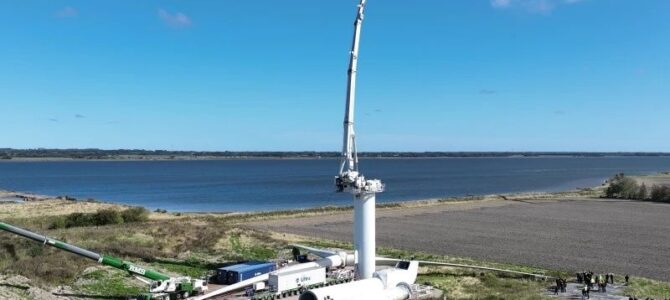
Haru Oni in Magallanes provides an important regional precedent. The project combines a Siemens Gamesa wind turbine, electrolysis supplied by Siemens Energy, and processes for producing synthetic carbon-neutral fuel. Its early production target was 130,000 liters of e-fuel annually, with planned expansion to much larger volumes. The significance lies less in the initial scale than in the integration challenge: wind generation, hydrogen production, carbon handling, synthesis, certification, and fuel logistics must operate as one commercial chain. A renewable resource can be excellent, but the project only works if every conversion and export step is reliable.
Patagonia also offers opportunities for direct industrial demand. Mining operations, desalination plants, ports, data infrastructure, steel facilities, and electro-intensive processing can be located closer to wind generation where land, water, and permitting conditions support them. A private line may still be needed inside a local industrial cluster, but the project avoids dependence on the full national corridor. The 2024 Central Puerto and IFC feasibility initiative for a potential high-voltage line to mining projects in the Puna illustrates how dedicated infrastructure can connect renewable supply with concentrated industrial demand. That proposed line was estimated at approximately 140 kilometers, with potential capacity of up to 400 MW and an estimated cost of US$600 million.
- Green hydrogen: Suitable for refining, chemicals, heavy transport, and future export chains, but dependent on electrolyzer utilization, water supply, storage, and firm buyers.
- E-fuels: Valuable where existing liquid-fuel logistics and engines remain important, although synthesis adds conversion losses and capital intensity.
- Mining and minerals: Direct renewable supply can improve emissions performance and reduce exposure to diesel or constrained grid electricity.
- Desalination: Wind-powered electricity can support water production for industrial development, provided brine management and water permits are addressed.
- Local industrial hubs: Co-locating several users can improve utilization of shared substations, roads, storage, and maintenance services.
The trade-off is capital intensity. Transmission expansion preserves electricity as electricity and can serve multiple buyers, but it requires long corridors, rights of way, substations, and system coordination. Chemical conversion avoids much of that network cost but introduces electrolyzers, synthesis equipment, storage tanks, water treatment, export terminals, and additional operating risk. Developers should compare the levelized cost of delivered electricity with the full delivered cost of the molecule, including conversion losses, certification, transport, offtake terms, and replacement equipment.
Building the Roadmap for Sustainable Southern Energy Capital
Patagonia”s wind opportunity should be approached through two complementary investment tracks. The first is transmission reinforcement, particularly where strong resource quality can be linked to industrial demand through privately financed lines, upgraded substations, and credible SADI access arrangements. The second is grid bypass, where hydrogen, e-fuels, mining, desalination, or other onsite industries convert local wind into a product that does not depend on national evacuation capacity. Neither pathway is universally superior. The right choice depends on distance to demand, congestion exposure, offtake certainty, conversion economics, water availability, and the sponsor”s tolerance for construction and regulatory risk.
Immediate diligence should include a corridor-level dispatch study, monthly curtailment sensitivities, a complete heavy-transport survey, site-specific wind and crane-window analysis, and a contractual review of interconnection rights. Developers should secure anchor offtakers early, while utilities and industrial buyers should assess whether shared transmission or local conversion creates greater long-term value. Investors should also require robust operating data, predictive maintenance systems, spare-parts plans, and realistic assumptions about currency and equipment replacement. With disciplined project selection, Patagonia can evolve from a remote generation frontier into an international renewable export and industrial platform. The resource is world class, but sustainable returns will belong to projects that solve delivery, not merely generation.